
Growing subscriptions through referral
- Apr 15
- 9 min read
Updated: 22 hours ago
eDreams ODIGEO, 2024-2025
eDreams is one of Europe's largest online travel agencies, operating in a highly competitive, price-sensitive market.
Prime is its annual membership product, offering exclusive travel discounts for a yearly fee and driving the company's primary recurring revenue.
At the time of this project, Prime was sold exclusively through the flight booking process. And we wanted to change this.

The real goal was to create a new subscription acquisition channel outside the booking funnel entirely. To do that, referral had to be designed across an entire commercial ecosystem. Every surface in the eDreams ecosystem was generating revenue for another team.
The opportunity had been discussed for years. Prime was a strong product, but subscription growth depended entirely on the booking funnel. The team knew users would subscribe outside that moment if given a real reason to, but no standalone path existed yet.
Referral became the opening move. Not just a growth mechanic, but the first product that would prove Prime could live outside the transactional funnel entirely.
My philosophy throughout simply was focusing on what state the user is in instead of what we are promoting. The goal was to find the moments where their attention and momentum were already engaged, and meet them there visually, contextually, and with a good experience.
That approach, applied iteratively across 7 rounds, produced a 60% uplift in conversion rate and over 100k new Prime members acquired entirely outside the booking funnel in the first year. It also opened the path for the first ever standalone Prime acquisition page, which launched after referral proved the demand existed.
Two Users, One System
Before building anything, I needed to understand two users equally: the person doing the referring, and the person being referred.
Their motivations, blockers, and trust thresholds were completely different and the system had to serve both.
In parallel, I mapped the competitive landscape and worked closely with Product Marketing to define how Prime's value should be communicated outside the booking funnel for the first time.
Competitive Benchmarking | Analyzed referral models across travel, fintech, and subscription products to understand incentive structures, timing strategies, and communication patterns. |
Referral Psychology & Trust Analysis | Studied trust transfer dynamics, reciprocity principles, perceived risk reduction, and why referred users often demonstrate higher loyalty and lifetime value. |
Motivators & Blockers Assessment | Identified what would make an existing subscriber feel confident recommending Prime, and what might hold them back. In parallel, analyzed what would motivate a referred user to join Prime without an active booking, and what barriers could prevent subscription. |
Standalone Value Framing | Defined how Prime’s value proposition should be communicated to someone encountering it outside the booking funnel. |
Product Marketing Collaboration | Worked closely with the Product Marketing team to refine positioning, incentive communication, and tone to ensure clarity, credibility, and commercial alignment. |
Referral Architecture
The system had to be as effortless as possible. Just one link that could be copied and shared with multiple people at once. The architecture covered the full journey: from the moment a subscriber decides to share, through the referred user's first encounter with Prime, all the way to reward visibility for both sides.
At a high level, the architecture consisted of:
Exposure
Referral was strategically distributed across high-relevance subscriber contexts, ensuring visibility without competing with critical transactional moments.
Share Mechanism
A lightweight interaction allowing subscribers to share a unique referral link without friction or navigation disruption.
Subscription
A dedicated Prime landing experience where the referred user could understand the membership and subscribe without booking a flight.
Validation
Travel credit reflected inside the account area and reinforced through email communication.

Design Process
The first question was not how to build the best referral experience. It was whether users would engage with referral at all outside the booking funnel.
1.Validating the Channel
The first question was not how to build the best referral experience. It was whether users would engage with referral at all outside the booking funnel.
As a team we agreed that starting with an MVP was the right call. Using existing components, keeping investment minimal and time-to-first-data short. I defined the existing components that can be used, entry points, the flow, and the constraints within that shared direction.
Two weeks to launch. Early traction validated the opportunity and gave us the organizational backing to invest further.
1.1 Widget and Landing Pages
For the widget, we used the structure of a promotianal Prime banner we use in the system, only by differentiating its background color since at some pages we have Prime banners and we don't want to use the very same widget at one page.
For its background color, I wanted use something lighter that can blend in the page but still in the design system to continue the coherence in the page between the transactional and promotional elements.


1.2 Personalisation
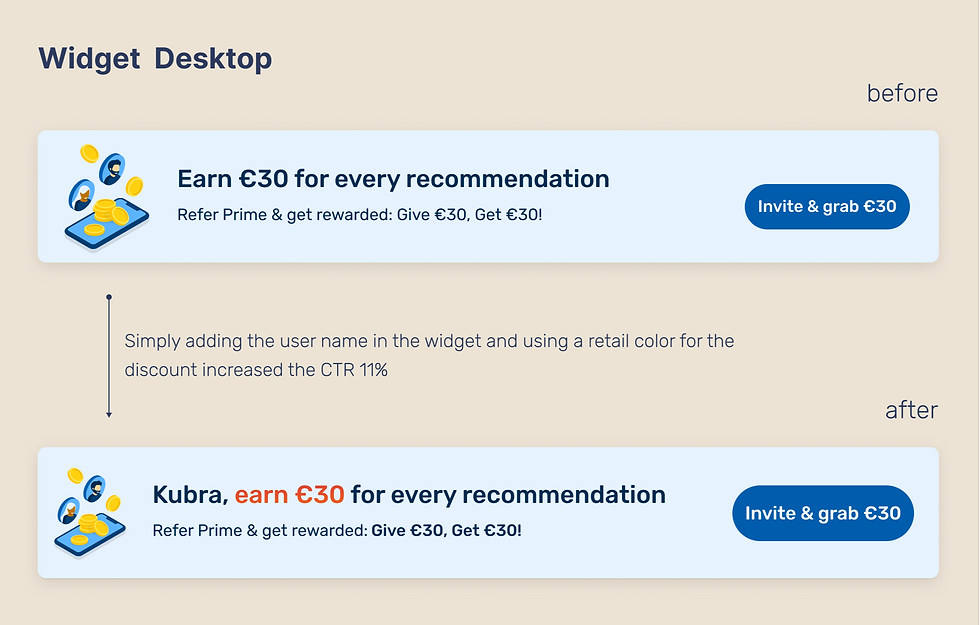
The next focus was the first personalization test. This idea came from an article I was reading about marketing emails, and impact of adding the user name on them. And I immediately suggested that very quick iteration to my PM.
Adding the name moved the price to the middle of the sentence, which I know from the researches, first word of the sentence is the thing the user captures and remembers.
So I had to to move "earn €30" word to the top in the visual hierarchy that the user captures at a glance. For that I used our deal color only for that word. And this made the user see the benefit the first and also still get the sense of the personalisation.
Adding the user's name and displaying the benefit in deal color drove an 11% CTR increase, an early signal that personal relevance mattered more than promotional volume.
1.3 Quick Share on Mobile
We also introduced a direct share action on mobile, allowing users to share without navigating to the landing page. The hypothesis was that the users already have the know-how of the referral programs.
I assigned the direct sharing to the CTA button to make it smoother for the user, and made the how it works significantly less visible.
I preferred a link button for "how it works" instead of a secondary button to keep the widget smaller, because by adding the quick share to the widget we also had to add the T&C to the widget. And cannot take so much space in a page, since the real estate in the funnel is highly valuable. Sharing increased significantly. The learning was, the visual hierarchy should follow the most needed action on the widget and people already understand how referral works. They do not need to be educated before they act. They need ease in their process.


2.Full Ownership of the Flow and the Decisions
The migration from CRM to product gave us direct ownership landing pages for the first time. Before this, the landing pages lived outside product team control.
With the migration we could make real design decisions about the flow, the interaction model, and the behavioral mechanics. Everything that follows in this chapter was made possible by that shift.
Being able to change how the landing pages work also opened a door for new possibilities for the widget as well.
2.1 Widget Changes
The widget was visible but underperforming. The team's instinct was to make it more prominent. I reframed the problem: users were not ignoring it because they could not see it, they were ignoring it because it did not feel trustworthy.
I looked at what was already working in the funnel. I adapted that exact structure to the referral widget. The fast track widget on the flight confirmation page had a clear structure: bullet points explaining the value, a pill used as a retailing technique, and an image that captured attention without disrupting the flow.
We shifted the background to white to match the transactional color system so it felt native to the moment, while keeping the retail techniques to maintain enough pull to drive action.
The bullet lists, the space the widget takes, clear and easily scannable visual hierarchy; all of these gave the referral more prominence and provided more trust to the user.
The balance was trusted enough to be read, compelling enough to be clicked. CTR increased 23% which is a significant increase.

2.3 Mobile quick share logic on desktop For the sender landing page, the team assumed a dedicated landing page would convert better by giving us space to communicate Prime's value fully. So for them, we should have just redesigned the page with the product design system. I pushed back.
My reasoning came from an observation: mobile was significantly outperforming desktop. I traced it to one difference.
On mobile, the device's native sharing mechanisms made the action feel instant and light. On desktop, users had to leave their current flow entirely to reach a separate page.
I proposed replacing the landing page with an in-context modal. The PM, research team, and design team were skeptical.
Also proposed to have the same quick share & how it works logic on desktop as well, and we created a completely new structure for both the widget and landing page.
We created two modal views, one just with the share functionality through the CTA button, assuming that the user already knows how a referral works. Second with a concise information we explain the referral shortly through the "how it works" link button.
The conversion increased 23% in total both with the changes in widget and the landing page.
The lesson was that in a high-intent transactional moment, reducing the cost of action matters more than increasing the depth of communication.


2.4 Prime Context for the Referred User
Users lacked understanding of Prime on the receiver side. So we wanted to add more information about Prime, and followed what already worked at the Prime landing page. But to build it in time, we were constrained by technical limitations.
I proposed an iterative rollout model where we introduced the landing page section by section, allowing us to ship while measuring the impact of each component.
This turned a technical constraint into a structured experimentation system, giving us clean data on what was actually driving conversion at each stage.
It also positioned design as a driver of both product and process decisions, not just execution.

3.Turning Passive Moments into Active Ones
3.1 Confirmation Email
Users were informed about their travel credit but not acting on it. The experience lived in CRM emails, which limited our design capabilities. When the migration from CRM to product happened,
I analysed how our capabilities would change with the migration from CRM and designed the new experience around what was now possible. Clear steps, a direct login CTA, and a coupon-based incentive.
I built the visual strategy to make the email more appealing, clear and actionable by using the retail technique for the discount and making it 'ticket like' to be used soon, making the discount code bigger and easily copyable, steps more
The shift from informational to action-driven produced a significant CTR increase and faster credit usage.

3.2 Confirmation Page
The confirmation step was treated as an endpoint. It was the most passive step of the whole flow. And again users saw it and immediatly closed it as we could see from the data.
I reframed it as an activation moment. Because this moment was important to create
By removing passive messaging and introducing an in-context modal with a clear copyable code CTA, we turned confirmation into the beginning of the next action rather than the end of the current one. This produced higher engagement and faster action after confirmation.

However this solution did not go live in its final form. The security team raised a legitimate GDPR concern: if a user signed up to Prime using someone else's email, the confirmation flow could expose that person's booking information to an unintended recipient. The risk was real and we respected it. The designs and the thinking behind them informed the next iteration, but the experience had to be restructured to resolve the data exposure risk before shipping.
Impact
Strategically, this work embedded trust-based advocacy into the subscription architecture while maintaining commercial balance.
Across 7 iterative rounds, conversion rate increased by 60%. The channel acquired over 100k new Prime members in its first year, entirely outside the booking funnel.
Specific design decisions produced measurable shifts:
Replacing the landing page with an in-context modal drove a 23% CTR increase
Adapting transactional UI patterns to the referral widget drove a significant CTR increase
Adding the user's name to the widget drove an 11% CTR increase
What Came Next
From the beginning we had argued that the app was the stronger channel for referral. App users are more loyal by nature: they downloaded the app, signed up, and actively engage with the product. The web experience was where we started because the technical capabilities existed there first, but the ROI per user on web did not justify the continued investment.
The web referral experience was eventually closed. The app team took our learnings, our designs, and the system we had built and launched referral on app, where the audience was right for it from the start.
Beyond referral, the work proved that Prime could grow outside the booking funnel entirely. That confidence directly led to the launch of the first ever standalone Prime acquisition page. What started as a referral program became the foundation for a new acquisition architecture.
Challenges
Designing inside a fully contested ecosystem with no guaranteed placements
Structuring a lifecycle across product and CRM with different ownership and speeds
Navigating GDPR constraints that reshaped what could be built after shipping
Balancing speed of validation with architectural coherence needed to scale
Serving two users whose trust thresholds required completely different approaches
Learnings
Architecture must be defined before interface when introducing a new product category
In high-intent moments, reducing the cost of action matters more than depth of communication
Trust drives engagement more effectively than visibility
Security and compliance constraints are important design inputs
Channel-audience fit matters as much as the product itself
Scalable acquisition mechanisms must be designed as systems, not features